


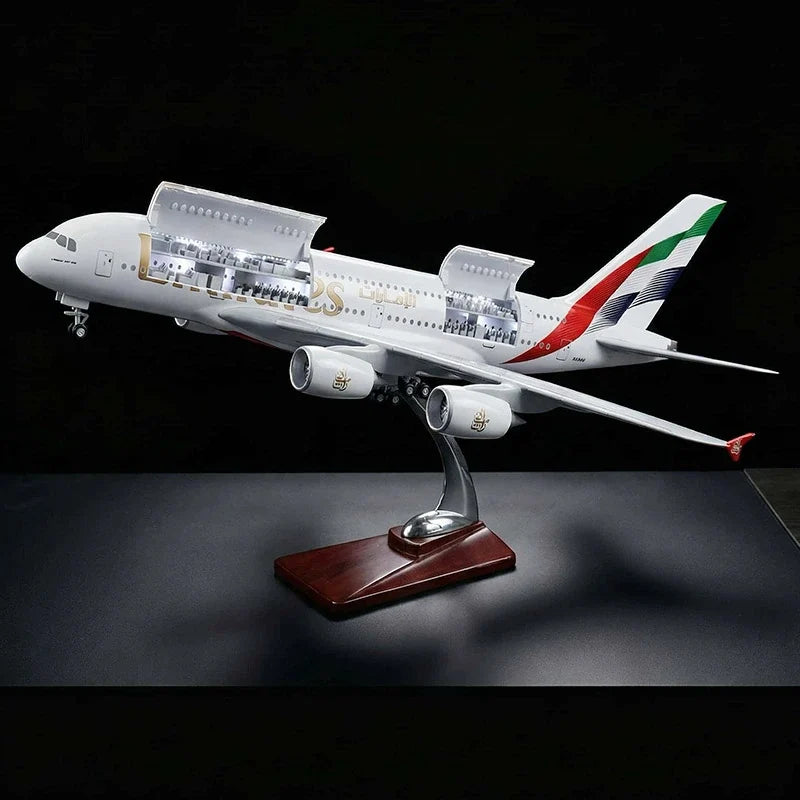
To clean a large aircraft model safely, remove loose dust with a soft brush, wipe smooth surfaces gently with a clean microfiber cloth and avoid spraying liquid directly onto the model. Models with LED lighting should always be switched off before cleaning.
Regular light cleaning is safer than waiting until a thick layer of dust has accumulated.
Quick answer
- Switch off any lighting.
- Hold the model by its fuselage or base.
- Remove dust with a soft brush.
- Wipe large surfaces with a dry microfiber cloth.
- Clean narrow areas with a cotton swab.
- Check the stand and base.
- Return the model to a dry, shaded display area.
Avoid alcohol, household cleaning sprays, abrasive cloths and excessive pressure.
What do you need to clean an aircraft model?
- A clean microfiber cloth
- A soft makeup or camera-lens brush
- Cotton swabs
- A manual air blower
- A separate cloth for the display base
- A small amount of clean water for stubborn marks
Use water only when necessary. The cloth or cotton swab should be slightly damp—not wet. Never apply liquid directly to the aircraft.
How often should you clean an aircraft model?
Lightly dust a model every one to two weeks if it is displayed on an open shelf. A model inside a closed cabinet may need cleaning only every four to eight weeks, depending on the room and cabinet seal.
Every few months, inspect dust around the engines and landing gear, fingerprints on the fuselage, stand stability, the wooden base, lighting controls and exposure to sunlight or moisture.
Step-by-step aircraft model cleaning guide
1. Turn off the lighting
If the model includes LED cabin lighting, switch it off before cleaning. Disconnect the power source or remove batteries when appropriate. Never clean around electrical parts while the lighting is operating.
2. Move the model carefully
Move the model by supporting the main fuselage or lifting the base and stand together. Do not lift it by a wingtip, tail, engine, landing gear or small exterior detail.
3. Remove loose dust
Use a soft brush to move dust away from the fuselage, wings and tail. Work from the upper surfaces downward. For engines, landing gear and narrow gaps, use a small brush or manual air blower and keep the airflow gentle.
4. Wipe the fuselage and wings
Use a clean, dry microfiber cloth with light pressure. Move in the direction of the aircraft body instead of rubbing in circles. Support the opposite side of the model when cleaning a large wing.

An A380 model has a broad wingspan, so clean one section at a time rather than applying pressure across the full wing.
5. Remove fingerprints or marks
For a stubborn mark, slightly dampen a microfiber cloth or cotton swab with clean water. Test it on a small, less visible area first. Wipe gently and immediately dry the surface with another cloth.
Do not use alcohol, acetone, glass cleaner, furniture polish, disinfectant, strong soap or abrasive pads. These products may affect paint, printed markings, adhesives or the surface finish.
6. Clean the stand and base separately
Use one cloth for the model and another for the stand and wooden base. A slightly damp cloth can be used on the base if necessary, but dry it immediately. Check that the stand remains stable before replacing the model.
How do you clean engines and landing gear?
Use a small soft brush, dry cotton swab or manual camera-lens blower. Do not push a cotton swab deeply into an engine opening because fibers may become trapped. Avoid canned compressed air at close range; strong airflow may damage small components or force condensation onto the surface.
How should you clean a Concorde model?
A Concorde model needs extra care around its pointed nose, wing edges and tail. The Xairmodel British Airways Concorde measures 50 cm long and 21 cm wide. Its narrow form is easy to access, but its length makes it important to support the fuselage while cleaning.

Place one hand beneath the main fuselage while wiping the nose or tail. Never use the pointed nose as a handle.
How should you clean an A380 model?
The Xairmodel 1:160 A380 measures 47 cm long with a 52 cm wingspan. Its width requires a stable work surface. Clean each wing separately and support it from beneath when necessary.
Pay particular attention to the four engines, the areas where the wings meet the fuselage, the tail surfaces, the upper side of the wings and the connection between the model and stand.
How do you protect LED aircraft models?
- Switch the lights off before cleaning.
- Keep water away from switches and connectors.
- Do not leave lighting powered continuously.
- Check the battery compartment periodically.
- Remove batteries before long-term storage.
- Keep the model away from high humidity.
If liquid enters an electrical opening, do not switch on the lights until the model is completely dry. Lighting availability can depend on the selected product configuration, so check the product page and variant before ordering.
Where should you display an aircraft model?
The best location is stable, dry and away from direct sunlight. Avoid open windows, heaters, cooking smoke, damp rooms, shelf edges and places easily reached by children or pets.
A closed display cabinet provides strong protection against dust, although the cabinet still needs occasional cleaning and ventilation.
Should you cover an aircraft model?
A transparent display case can reduce dust and accidental contact. Make sure the cover does not touch the wings, nose or tail. Before ordering a case, measure the model’s actual length, wingspan, height and stand—not just its scale.
For sizing advice, read How Much Space Do You Need for a Large Aircraft Model?
How do you store an aircraft model long term?
- Clean and dry it first.
- Remove batteries if applicable.
- Leave space around small details.
- Avoid pressure on the wings or tail.
- Store it in a dry location.
- Keep it away from extreme temperatures.
- Use the original packaging when available.
Do not wrap painted surfaces tightly with rough paper or plastic that may rub against the finish.
Common aircraft model cleaning mistakes
Spraying cleaner directly onto the model
Liquid can enter small gaps, affect printed details or reach the lighting system.
Lifting the model by a wing
The fuselage or display base is usually the safer lifting point.
Using a rough cloth
Abrasive fabric can leave fine marks on glossy surfaces.
Applying too much pressure
Small details can bend or loosen even when the main body feels solid.
Leaving batteries installed during storage
Old batteries can leak and damage the internal lighting system.
Displaying the model in direct sunlight
Repeated exposure can gradually affect surface colors and finishes.
Final recommendation
The safest way to maintain a large aircraft model is to clean it gently and regularly. Use a soft brush and microfiber cloth, support the fuselage while handling it, keep moisture away from lighting components and display the model in a stable location away from direct sunlight.
A few minutes of careful maintenance every few weeks is usually enough to keep an aircraft model clean and display-ready.
Frequently asked questions
Can I wash an aircraft model with water?
Do not wash or immerse the model. For stubborn marks, use only a slightly damp cloth and dry the area immediately.
Can I use alcohol to clean a model airplane?
It is best to avoid alcohol because it may affect paint, printed markings, adhesives or the surface finish.
Can I use compressed air?
A gentle manual air blower is safer. High-pressure canned air used at close range may damage small details or release condensation.
How do I remove dust from model aircraft engines?
Use a small soft brush or dry cotton swab. Avoid inserting tools deeply into the engine opening.
Should batteries be removed during storage?
Yes. Remove batteries before long-term storage to reduce the risk of leakage and damage.
Is a display cabinet necessary?
No, but a cabinet or transparent cover can substantially reduce dust and accidental contact.
Partager:
Are Large Aircraft Models Worth Buying?
Les grandes maquettes d’avion valent-elles le coup ?